Time is a funny thing…
Time is a funny thing. For most of human history, it wasn’t something people could point to or measure. It was just… there. The light changed, the air cooled, and that was enough. Days blended into seasons, work ended when the shadows got long, and nobody really minded if “later” meant twenty minutes or two hours.
Then one day, someone decided the world needed a little more structure. They marked the sun’s path, divided it up, and gave each part a name. Suddenly, life had edges. Mornings began at dawn, evenings ended at dusk, and somewhere between those two we invented schedules. It’s strange, our entire civilization depends on imaginary lines we drew across the sky.
We’ve been refining those lines ever since. Sundials became water clocks, then pendulums, then springs and gears, then quartz crystals and atomic pulses. Each generation made time a little sharper, a little more precise. The clock stopped being a rough guess and started being a ruler, one that measured not distance, but existence itself.
It’s funny to think how arbitrary it all is. Sixty seconds, sixty minutes, twenty-four hours, numbers chosen long ago, that we still treat like law. We built calendars and time zones around royal whims and practical guesses, and now they govern everything from plane departures to work shifts. If you step back, it’s astonishing how much our sense of order depends on what started as pure invention.
Before long, being “on time” became a moral quality. Trains couldn’t run on “close enough.” Factories needed whistles. The industrial world demanded punctuality, and with it came anxiety. Being late meant failing the system. Time, once a rhythm, became a scoreboard. We went from living with time to living by it.
And yet, precision gave us progress. The same urge that built clocks built cities, ships, computers, and satellites. Our GPS systems and trading floors rely on clocks accurate to billionths of a second. The heartbeat of modern life is mechanical. Somewhere along the way, we stopped listening to the sun and started listening to the tick.
But here’s where it gets interesting: the more precise our clocks became, the more we seemed to crave moments that weren’t measured. A quiet morning coffee, a conversation that stretches past midnight, an old watch ticking softly on the nightstand. Those are the moments that remind us why time matters in the first place, not because we can count it, but because we can feel it passing.
The craft of watch repair is really a meditation on that paradox. You hold a device designed to measure time, yet to fix it you have to step outside of time entirely, steady hands, patient focus, no rush. It’s precision built on calm. The kind of precision that reminds you how strange it is that a few millimeters of metal can keep an entire life running on schedule.
Time was always nebulous, until it wasn’t. We caught it, caged it, and now it rules us as much as we rule it. But in those rare moments when a vintage movement starts ticking again, or a worn-down crystal catches the light just right, you realize something deeper: time might be an invention, but our reverence for it is real.
So yes, time is a funny thing. It’s both illusion and reality, strict and forgiving. It’s the heartbeat of every clock and the silence between ticks. And for those of us who spend our days keeping it running, it’s proof that even the most arbitrary human ideas can become beautiful when treated with care.
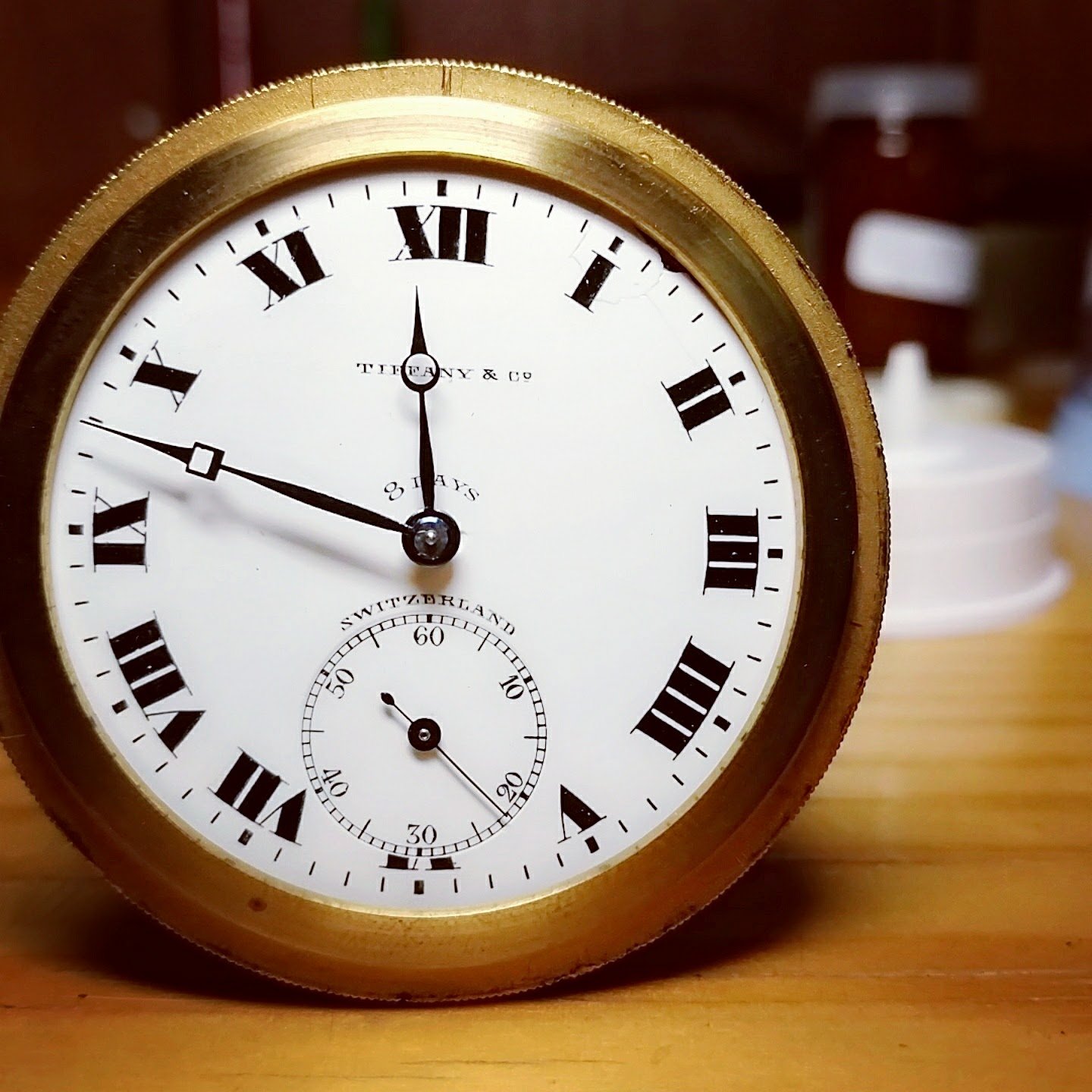
Tiffany & Co. 8 Day travel clock pictured.