Magnetism: The Invisible Enemy of Accuracy
Every watchmaker eventually develops a sense for when something inside a movement does not feel right. A watch arrives running fast or slow by a wide margin, sometimes erratic enough to make the owner think the movement is failing. But more often than not, the culprit is something the eye cannot see. Magnetism has a way of slipping into a watch silently and leaving chaos behind.
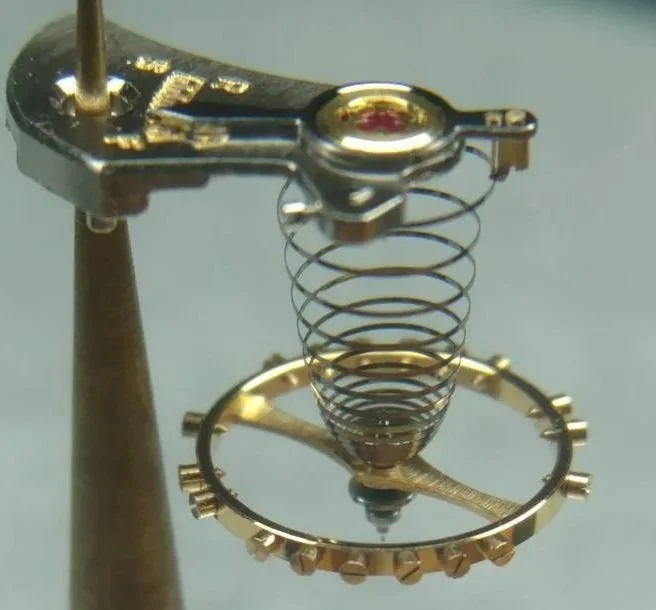
Magnetism has always been a threat to mechanical timekeeping, but modern life has made it far more common. Phones, laptops, tablets, speakers, charging coils and countless other everyday objects create magnetic fields strong enough to influence a watch. Even the magnetic clasp on a purse or the cover of a tablet can leave a movement affected. It is easy to forget how vulnerable a balance spring is until it becomes magnetized. When the coils begin to stick together, the rhythm of the watch changes instantly. Instead of breathing evenly, the spring shortens itself with each turn and the rate jumps ahead by minutes a day.
The balance spring is really at the center of the problem. It is a thin, delicate strip of metal that governs the timing of the entire movement. When a magnetic field interacts with it, the coils can cling to one another or distort the way the spring opens and closes. Even a small amount of magnetism can throw everything off. Watches that normally keep excellent time suddenly run wildly fast, or they become inconsistent with no pattern at all. It is the kind of issue that puzzles owners but is obvious the moment a watchmaker puts it near a demagnetizer.
The interesting part is that magnetism does not damage the movement mechanically. It does not scratch gears, bend wheels or harm the jewels. It simply interferes with the natural motion of the regulating system. This is why a watch can seem completely fine one day and dramatically off the next. It only needs a brief moment near a strong magnetic field. That moment can happen while leaning on a laptop, setting a phone next to the watch on a nightstand or resting a wrist on a magnetic clasp without thinking twice.
The good news is that magnetism is easy to fix. A demagnetizer can clear the entire movement in a second. Once the field is gone, the watch returns to its true rate and the balance spring breathes normally again. For many watches that come into the shop running unusually fast, demagnetizing is the first thing checked. More often than not, it solves the problem immediately. It is one of the rare issues in watchmaking where the solution is simple but the cause is frustratingly subtle.
Some brands have taken big steps to defend against this invisible enemy. Modern alloys like silicon and materials used in contemporary hairsprings resist magnetism far better than traditional steel. Companies like Omega, Rolex and others have pushed anti magnetic technology far ahead of where it used to be. But countless watches in circulation still rely on older hairspring materials, and those remain as vulnerable as ever. A vintage piece or a daily wearer from a few decades ago has very little protection against the fields that fill our modern environment.
You can often tell when a watch has been magnetized without even touching it. A sudden gain of several minutes per day, a movement that runs oddly fast on the wrist but settles down off the wrist, or timing results that fluctuate dramatically are all common signs. But nothing confirms it like the quick test at the bench. The moment the watch is demagnetized and snaps back to accurate timekeeping, the mystery resolves itself.
In the shop, it is always interesting to see how people react when told their watch was simply magnetized. There is relief mixed with surprise. The invisible nature of the problem catches many off guard. It also serves as a reminder of how delicate and finely balanced these machines are. A movement that has run faithfully for years can still be influenced by something it never touches and never sees.
The fight against magnetism is not dramatic. It does not grind gears or break parts. Instead it quietly reaches into the heartbeat of the watch and nudges it out of rhythm. But with a simple pass over a demagnetizer, everything returns to harmony again. In a world full of magnetic fields, it remains one of the most persistent and unseen challenges in keeping time. Yet it is also one of the easiest to correct, which makes it a strangely satisfying problem to solve.